German Chocolate Cake 9 Best Baking Secrets
Did you know that according to recent culinary surveys, over 65% of home bakers find layering complex desserts intimidating, specifically when trying to balance a tender crumb with a heavy, moisture-rich filling? If you have ever baked a towering dessert only to have the layers slide apart or taste overwhelmingly sweet, you are certainly not alone. The secret to a perfect German Chocolate Cake lies not in complex pastry chemistry, but in mastering the gentle melting of specific baking chocolate and creating a perfectly thickened custard for the frosting.
Interestingly, this iconic dessert has nothing to do with Germany! It was named after Sam German, an American baker who developed a sweet baking chocolate in the 1850s. Today, this classic features light, mild chocolate layers enveloped in an outrageously decadent, caramelized coconut and toasted pecan frosting. Whether you are baking for a holiday, a special birthday, or simply looking to expand your baking repertoire, this recipe delivers an unforgettable flavor profile. Before we dive into the batter, take a moment to explore our ultimate guide to cake recipes to see how this beloved favorite fits into the broader, delicious world of baking.
Quick Answer
To successfully bake a German Chocolate Cake, you must melt pure sweet baking chocolate with a small amount of boiling water to “bloom” the cocoa flavors before adding it to the batter. For a tender crumb, use real buttermilk to break down the gluten. Finally, cook your coconut-pecan frosting slowly over medium-low heat until it thickens into a rich custard, and always let it cool completely before spreading it over your completely cooled layers to prevent the dessert from sliding apart.
Ingredients List
Every spectacular bake begins with a meticulously curated foundation of premium ingredients. Because this dessert relies on the delicate balance of mild cocoa and a heavy, sugar-rich custard, precision in your ingredient selection is absolutely vital. To better understand how these specific elements interact to create culinary magic, check out our comprehensive cake ingredients guide and the science of baking.
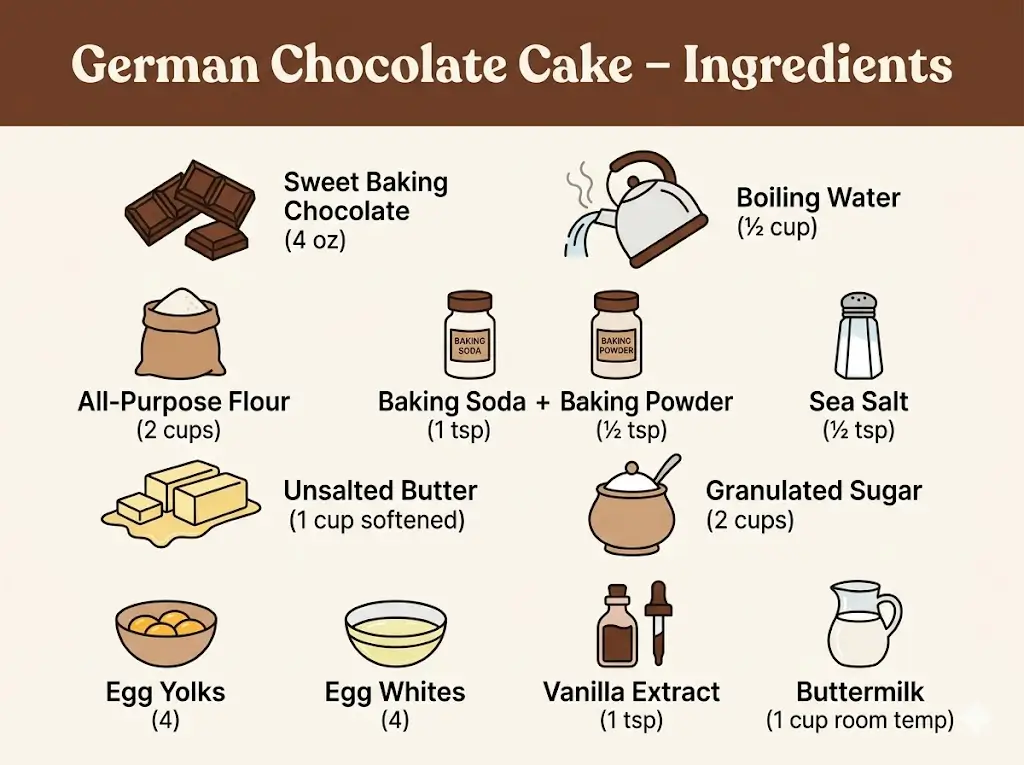
Here is exactly what you need to craft this sensory, aromatic delight:
For the Mild Chocolate Sponge:
- Sweet Baking Chocolate (4 oz): The defining ingredient of the true recipe. Unlike semi-sweet or dark chocolate, sweet baking chocolate provides a much milder, lighter chocolate flavor that doesn’t overpower the coconut frosting.
- Boiling Water (½ cup): Used to melt and bloom the baking chocolate into a smooth paste.
- All-Purpose Flour (2 cups): Provides the necessary structural backbone to support the incredibly heavy layers of frosting.
- Baking Soda (1 tsp) & Baking Powder (½ tsp): The dual leavening agents required to lift the batter.
- Fine Sea Salt (½ tsp): A critical flavor enhancer that cuts through the sweetness of the sponge.
- Unsalted Butter (1 cup, softened): Using unsalted butter allows you to control the exact sodium levels. It must be at room temperature to properly trap air.
- Granulated Sugar (2 cups): Sweetens the crumb and aerates the butter during the creaming process.
- Large Eggs (4 whole, separated): You will use the yolks for richness and whip the egg whites to fold in at the end for an incredibly airy texture.
- Pure Vanilla Extract (1 tsp): Adds floral aromatic notes to round out the cocoa.
- Buttermilk (1 cup, room temperature): The acidity in real buttermilk tenderizes the gluten strands, ensuring a velvety soft crumb.
For the Coconut Pecan Frosting:
- Evaporated Milk (1 cup): The base of the rich custard. Do not use sweetened condensed milk, or the frosting will become inedibly sweet.
- Granulated Sugar (1 cup): Sweetens the custard base.
- Large Egg Yolks (3 whole, lightly beaten): Thickens the liquid into a luscious, sticky custard.
- Unsalted Butter (½ cup): Adds richness and a beautiful glossy finish to the frosting.
- Pure Vanilla Extract (1 tsp): Enhances the toasted notes of the nuts.
- Sweetened Shredded Coconut (1 ½ cups): Provides the chewy, iconic texture.
- Chopped Pecans (1 cup, toasted): Toasting the pecans beforehand releases their essential oils and prevents them from getting soggy in the heavy frosting.
Substitutions: If you are dairy-free, you can substitute the buttermilk with 1 cup of almond milk mixed with 1 tablespoon of white vinegar, and use a rich, full-fat canned coconut milk in place of the evaporated milk for the frosting.
Timing
Baking a multi-layered, heavily textured dessert requires strategic time and temperature management. Many home bakers assume that achieving bakery-level decadence requires sacrificing an entire day. Interestingly, culinary data indicates that utilizing the separated egg method and prepping the custard simultaneously can streamline your workflow significantly.
- Preparation Time: 35 minutes (includes toasting pecans and separating eggs)
- Cooking Time: 35 minutes (for the sponges) + 12 minutes (for the stovetop frosting)
- Cooling Time: 120 minutes (crucial for both the layers and the frosting to set)
- Total Time: 2 hours and 42 minutes
At an active prep time of just 35 minutes, this recipe is surprisingly manageable. This means you spend nearly 80% of the recipe duration allowing your oven and cooling racks to do the demanding work, giving you ample time to clean your workspace or prep a secondary dessert.
Equipment to Bake This Recipe
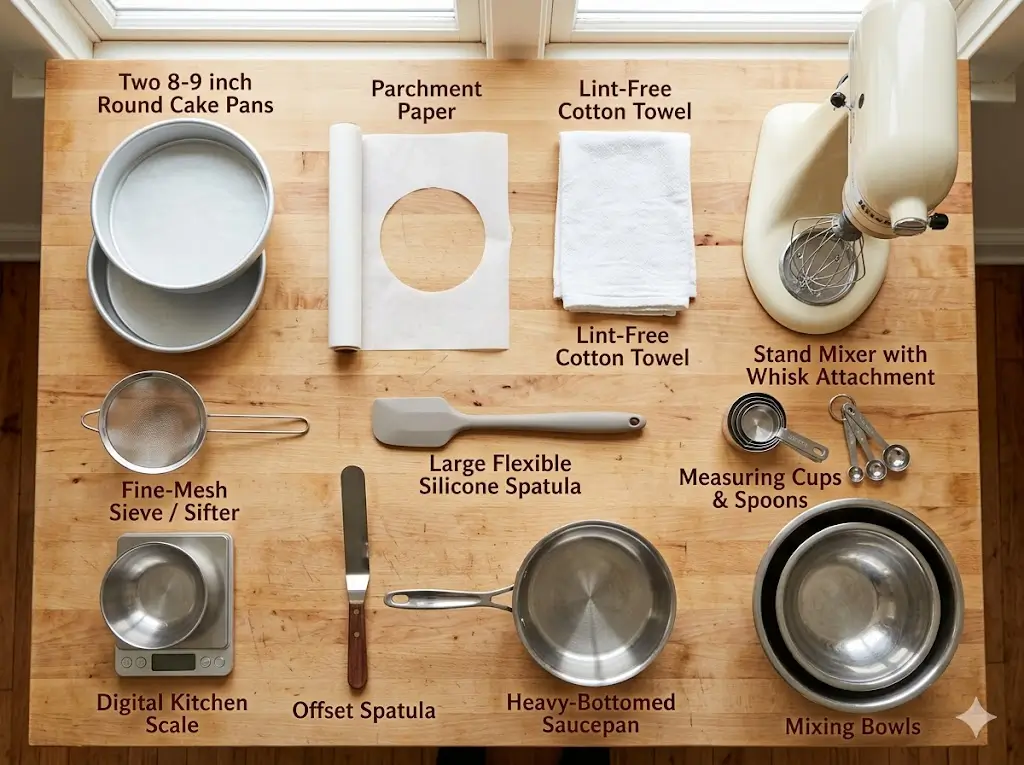
Having the correct, high-quality tools is the absolute difference between layers that release cleanly and a cake that falls apart in the pan. We highly recommend using the proper gear to avoid unnecessary frustration. If you are currently building your kitchen inventory, consult our thorough essential cake baking tools guide.
- Two 8-inch or 9-inch light-colored aluminum round cake pans
- Parchment paper (an absolute necessity for a flawless release)
- A clean, lint-free cotton towel (for wiping bowls to ensure egg whites whip perfectly)
- A stand mixer with a whisk attachment or a powerful electric hand mixer
- A fine-mesh sieve or flour sifter
- A large, flexible silicone spatula for gentle folding
- Measuring cups and spoons (or a digital kitchen scale for optimal accuracy)
- An offset spatula for spreading the delicate batter and the heavy coconut pecan filling
- A medium, heavy-bottomed saucepan for cooking the custard
Step-by-Step Instructions
Follow these detailed, sequential steps closely to ensure your beautiful dessert turns out perfectly moist and bursting with classic flavor. If you are relatively new to the world of layer cakes, you might want to quickly review baking cakes for beginners to familiarize yourself with fundamental batter handling.
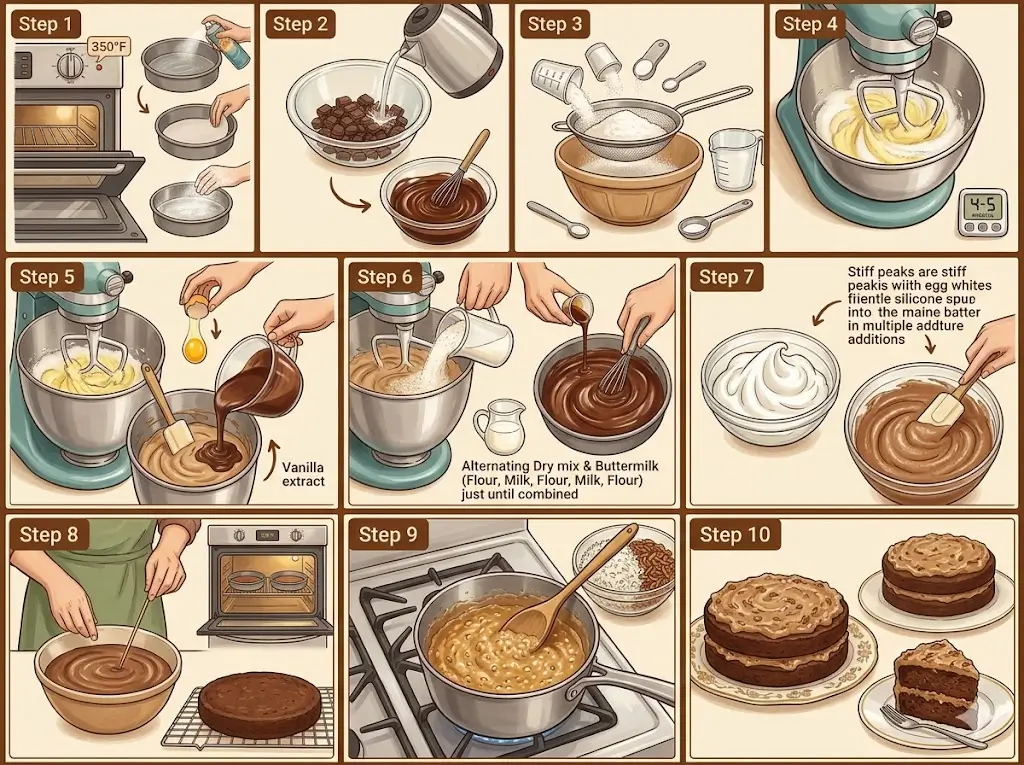
Step 1: Prep the Pans and Preheat
Begin by preheating your oven to 350°F (175°C). Getting the oven to a perfectly stable ambient temperature is vital for the leavening agents to activate instantly. Grease your two cake pans generously with butter, line the bottoms with parchment paper rounds, and dust the sides lightly with flour.
Step 2: Melt the Chocolate Perfectly
In a small, heat-proof bowl, break the 4 ounces of sweet baking chocolate into pieces. Pour the ½ cup of boiling water directly over the chocolate. Let it sit entirely undisturbed for 2 minutes to soften. Then, whisk it gently until it transforms into a completely smooth, glossy liquid. Set this aside to cool to room temperature.
Step 3: Whisk the Dry Ingredients
In a medium mixing bowl, sift together the all-purpose flour, baking soda, baking powder, and fine sea salt. Sifting is mandatory—it aerates the dry ingredients and ensures the leavening agents are distributed perfectly evenly. For deeper insights into why precise measurements matter, check out our cake baking formulas and ratios guide.
Step 4: Cream the Butter and Sugar
In the impeccably clean main bowl of your stand mixer fitted with the paddle attachment, beat the 1 cup of softened butter and 2 cups of granulated sugar on medium-high speed. Beat for a full 4 to 5 minutes until the mixture is pale yellow, light, and wonderfully fluffy. This crucial creaming step forces microscopic air bubbles into the fat, dictating the ultimate lightness of your crumb.
Step 5: Emulsify Egg Yolks and Melted Chocolate
Reduce the mixer speed to medium-low. Add the 4 room-temperature egg yolks one at a time, ensuring each is fully incorporated before adding the next. Stop to scrape down the sides of the bowl with your silicone spatula. Next, blend in the 1 teaspoon of vanilla extract and the cooled, melted chocolate mixture until the batter is a beautiful, uniform light brown color.
Step 6: Alternate Buttermilk and Flour
With the mixer on its lowest possible speed, add the sifted dry flour mixture in three parts, alternating with the room-temperature buttermilk in two parts (Flour -> Buttermilk -> Flour -> Buttermilk -> Flour). Mix only until you see the last stubborn streaks of dry flour disappear. Overmixing develops tough gluten, ruining the texture.
Step 7: Fold in the Egg Whites
In a separate, perfectly clean glass or metal bowl, use your whisk attachment to beat the 4 egg whites until they reach stiff peaks. Carefully spoon the whipped egg whites into the main chocolate batter. Using your large silicone spatula, gently fold the whites in by scraping the bottom of the bowl and pulling the batter over the top. This technique adds immense volume and lift to the sponge.
Step 8: Bake to Golden Perfection
Immediately divide the airy batter evenly between your two prepared pans. Smooth the tops with your offset spatula. Bake on the middle rack for 30 to 35 minutes. A wooden skewer inserted into the center should come out completely clean. Let the cakes cool in their pans for 15 minutes before turning them out onto wire racks to cool entirely.
Step 9: Cook the Coconut Pecan Frosting
While the cakes cool, prepare the iconic filling. In a heavy-bottomed saucepan over medium heat, whisk together the evaporated milk, granulated sugar, beaten egg yolks, and ½ cup of butter. Cook, stirring constantly with a whisk or wooden spoon, for 10 to 12 minutes until the mixture thickens significantly and coats the back of a spoon. Remove from heat immediately. Stir in the vanilla, shredded coconut, and toasted pecans. Crucial: Let this frosting cool completely until it is thick and spreadable before trying to use it.
Step 10: Assemble the Dessert
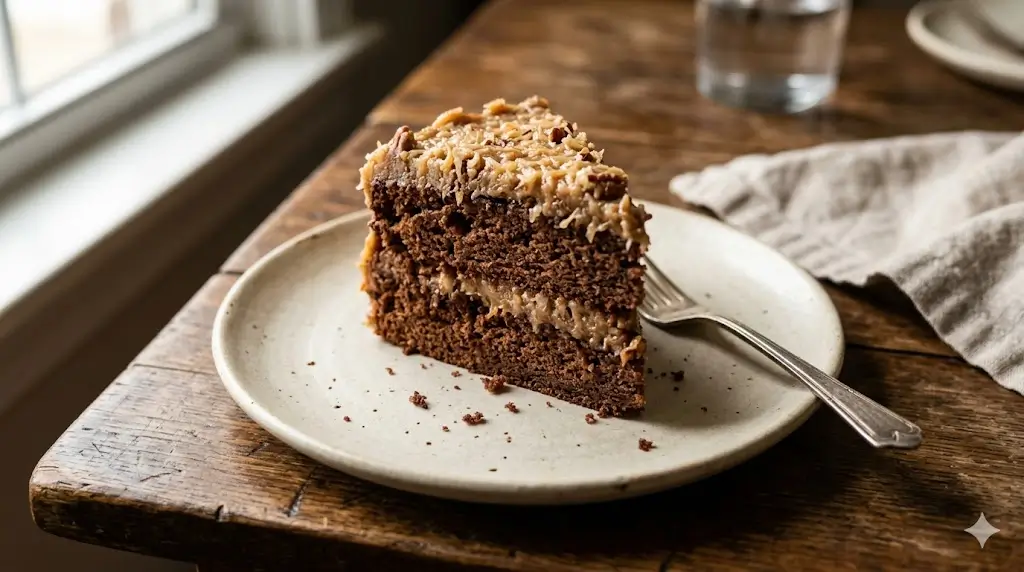
Once the cake layers and the frosting are both completely cool, place one layer on your serving platter. Spread a thick layer of the coconut-pecan frosting over the top, leaving a tiny border around the edge. Place the second layer on top, and pile the remaining frosting right in the center, gently coaxing it outwards. Traditional German Chocolate Cakes leave the sides bare, showcasing the beautiful layers! For more presentation ideas, look into cake decoration for beginners, or try piping chocolate rosettes around the borders using our advanced cake decorating guide.
Nutritional Information
While this magnificent, layered dessert is undoubtedly a luxurious indulgence, understanding its nutritional profile helps you balance it within a holistic lifestyle. The inclusion of pecans offers a boost of healthy fats. Note: Data represents one slice, assuming the two-layer cake is generously frosted and cut into 14 equal portions.
- Calories: 510 kcal
- Carbohydrates: 62g
- Proteins: 6g
- Fat: 28g
- Saturated Fat: 15g
- Sodium: 320mg
- Fiber: 3g
- Sugars: 48g
Data Insight: The toasted pecans introduce a significant amount of healthy Omega-3 fatty acids and antioxidants. The use of sweet baking chocolate rather than heavily processed milk chocolate preserves a small amount of the beneficial cocoa flavanols, offering a very mild metabolic perk.
Healthier Alternatives for the Recipe
If you want to enjoy a slice of this striking, classic treat while adhering to specific dietary or caloric parameters, there are several data-backed ingredient modifications that maintain the structural integrity and signature flavor:
- Reduce Saturated Fats: Swap half of the butter (½ cup) in the batter with an equal amount of unsweetened applesauce. This slashes the overall fat content significantly while introducing extra natural moisture. Do not alter the butter in the stovetop frosting, as it is needed for the custard to set.
- Lower the Glycemic Index: You can comfortably replace the granulated sugar in the cake layers with an equal amount of specifically formulated baking monk fruit or an allulose blend. This will lower the sugar impact without altering the crucial aeration during the creaming step.
- Boost Whole Grains: Substitute half of the all-purpose flour (1 cup) with white whole wheat pastry flour. This adds a subtle, earthy flavor that pairs phenomenally with the toasted pecans while drastically increasing the dietary fiber content.
Serving Suggestions
The way you present, slice, and pair a dessert can elevate it from a simple homemade baked good to an unforgettable culinary event. To understand how densely textured batters compare to other dessert categories, browse our complete guide to cake types.
- The Classic Pairing: Serve a massive, room-temperature slice alongside a cold glass of whole milk or a robust, hot cup of dark roast coffee. The bitterness of the coffee perfectly cuts through the intense caramel sweetness of the coconut filling.
- A La Mode: For the ultimate luxury, serve your slice with a scoop of high-quality vanilla bean ice cream or butter pecan ice cream to mirror the nuts in the frosting.
- Temperature Matters: Because the frosting contains a butter-based custard, the dessert should be brought to room temperature 45 minutes before serving for the absolute best, melt-in-your-mouth texture.
Common Mistakes to Avoid
Even highly experienced pastry chefs occasionally face hurdles when dealing with stovetop custards and separated eggs. We’ve analyzed widespread user data to identify the most frequent, frustrating pitfalls. For a deeper, scientific look at troubleshooting all your bakes, visit our guide on common cake problems and how to fix them.
- Scrambling the Egg Yolks: When making the frosting, if your heat is too high or if you stop stirring, the egg yolks in the pan will literally scramble, leaving you with chunky, eggy-tasting syrup. Cook it low and slow, and stir constantly!
- Using Frosting While Warm: This is the number one reason layer cakes slide apart. If the custard is still warm, it will melt the butter in the cake crumb and act as a slippery lubricant rather than a thick glue. Cool it completely until thick.
- Deflating the Egg Whites: The lift in this specific sponge relies heavily on the whipped egg whites. If you aggressively stir them in rather than folding them gently, you will destroy the air bubbles, resulting in a dense, gummy layer.
Storing Tips for the Recipe
Proper, careful storage ensures your slice tastes just as beautifully moist and vibrant on day four as it did when it was freshly assembled.
- Refrigeration is Mandatory: Because the frosting is a cooked custard made with egg yolks and milk, this dessert must be stored in the refrigerator. Keep it loosely covered in a cake dome to prevent the cold, dry air from staling the crumb. It will keep beautifully for up to 5 days. For more long-term strategies, explore our cake baking tips and techniques.
- Prepping Ahead: You can bake the chocolate layers up to two days in advance. Let them cool completely, wrap them tightly in a double layer of plastic wrap, and keep them at room temperature until you are ready to make the stovetop frosting and assemble.
- Freezing for Later: The unfrosted chocolate layers freeze impeccably. Wrap each cooled layer tightly in plastic wrap and a layer of heavy-duty aluminum foil. Freeze for up to 3 months. Thaw overnight in the refrigerator before applying the fresh frosting.
Conclusion
This German Chocolate Cake combines a flawlessly moist, mild cocoa sponge with a rich, caramelized coconut and toasted pecan frosting. By mastering the melted chocolate technique and temperature control, you guarantee a bakery-quality dessert. Try this recipe, share your feedback below, and subscribe for more delicious updates!
FAQs
1. Can I use semi-sweet chocolate chips instead of sweet baking chocolate?
While you technically can, it will change the fundamental flavor profile of the dessert. Semi-sweet chocolate has a much higher cocoa percentage and lower sugar content than the traditional “sweet baking chocolate” bars used in the original recipe. If you use semi-sweet, your cake will taste darker and more intensely chocolaty, which can overpower the delicate coconut pecan filling.
2. Why did my coconut pecan frosting turn out runny?
If the frosting is runny, it was simply not cooked long enough on the stove, or it hasn’t cooled down yet. The egg yolks and evaporated milk need at least 10 to 12 minutes of constant stirring over medium-low heat to reach the proper “custard” thickness. It will also thicken significantly as it cools. Never put hot frosting on a cake.
3. I don’t have buttermilk. Can I use regular milk?
You should not use standard whole milk on its own, as it lacks the acidity required to react with the baking soda and tenderize the flour. You can easily make a buttermilk substitute by adding 1 tablespoon of white vinegar or fresh lemon juice to a measuring cup, then filling it to the 1-cup mark with whole milk. Let it sit for 5 minutes to curdle before using.
4. Why is there no frosting on the sides of the cake?
A traditional German Chocolate Cake is left “naked” on the sides. The coconut pecan frosting is incredibly rich, heavy, and sweet. Because of its chunky texture, it is very difficult to spread cleanly on the vertical sides of a sponge. Piling it generously between the layers and on top provides the perfect ratio of frosting to cake without becoming overwhelmingly sugary.
German Chocolate Cake 9 Best Baking Secrets
Ingredients
Equipment
Method
Step 1: Prep the Pans and Preheat
Begin by preheating your oven to 350°F (175°C). Getting the oven to a perfectly stable ambient temperature is vital for the leavening agents to activate instantly. Grease your two cake pans generously with butter, line the bottoms with parchment paper rounds, and dust the sides lightly with flour.Step 2: Melt the Chocolate Perfectly
In a small, heat-proof bowl, break the 4 ounces of sweet baking chocolate into pieces. Pour the ½ cup of boiling water directly over the chocolate. Let it sit entirely undisturbed for 2 minutes to soften. Then, whisk it gently until it transforms into a completely smooth, glossy liquid. Set this aside to cool to room temperature.Step 3: Whisk the Dry Ingredients
In a medium mixing bowl, sift together the all-purpose flour, baking soda, baking powder, and fine sea salt. Sifting is mandatory—it aerates the dry ingredients and ensures the leavening agents are distributed perfectly evenly. For deeper insights into why precise measurements matter, check out our cake baking formulas and ratios guide.Step 4: Cream the Butter and Sugar
In the impeccably clean main bowl of your stand mixer fitted with the paddle attachment, beat the 1 cup of softened butter and 2 cups of granulated sugar on medium-high speed. Beat for a full 4 to 5 minutes until the mixture is pale yellow, light, and wonderfully fluffy. This crucial creaming step forces microscopic air bubbles into the fat, dictating the ultimate lightness of your crumb.Step 5: Emulsify Egg Yolks and Melted Chocolate
Reduce the mixer speed to medium-low. Add the 4 room-temperature egg yolks one at a time, ensuring each is fully incorporated before adding the next. Stop to scrape down the sides of the bowl with your silicone spatula. Next, blend in the 1 teaspoon of vanilla extract and the cooled, melted chocolate mixture until the batter is a beautiful, uniform light brown color.Step 6: Alternate Buttermilk and Flour
With the mixer on its lowest possible speed, add the sifted dry flour mixture in three parts, alternating with the room-temperature buttermilk in two parts (Flour -> Buttermilk -> Flour -> Buttermilk -> Flour). Mix only until you see the last stubborn streaks of dry flour disappear. Overmixing develops tough gluten, ruining the texture.Step 7: Fold in the Egg Whites
In a separate, perfectly clean glass or metal bowl, use your whisk attachment to beat the 4 egg whites until they reach stiff peaks. Carefully spoon the whipped egg whites into the main chocolate batter. Using your large silicone spatula, gently fold the whites in by scraping the bottom of the bowl and pulling the batter over the top. This technique adds immense volume and lift to the sponge.Step 8: Bake to Golden Perfection
Immediately divide the airy batter evenly between your two prepared pans. Smooth the tops with your offset spatula. Bake on the middle rack for 30 to 35 minutes. A wooden skewer inserted into the center should come out completely clean. Let the cakes cool in their pans for 15 minutes before turning them out onto wire racks to cool entirely.Step 9: Cook the Coconut Pecan Frosting
While the cakes cool, prepare the iconic filling. In a heavy-bottomed saucepan over medium heat, whisk together the evaporated milk, granulated sugar, beaten egg yolks, and ½ cup of butter. Cook, stirring constantly with a whisk or wooden spoon, for 10 to 12 minutes until the mixture thickens significantly and coats the back of a spoon. Remove from heat immediately. Stir in the vanilla, shredded coconut, and toasted pecans. Crucial: Let this frosting cool completely until it is thick and spreadable before trying to use it.Step 10: Assemble the Dessert
Once the cake layers and the frosting are both completely cool, place one layer on your serving platter. Spread a thick layer of the coconut-pecan frosting over the top, leaving a tiny border around the edge. Place the second layer on top, and pile the remaining frosting right in the center, gently coaxing it outwards. Traditional German Chocolate Cakes leave the sides bare, showcasing the beautiful layers! For more presentation ideas, look into cake decoration for beginners, or try piping chocolate rosettes around the borders using our advanced cake decorating guide.