Go Back
Matcha Green Tea Chiffon Cake 7 Best Baking Tips

Matcha Green Tea Chiffon Cake 7 Best Baking Tips

Tired of dense desserts? Bake a fluffy Matcha Green Tea Chiffon Cake with our top tips for a perfect rise and earthy flavor. Discover, Learn, Try.
Prep Time 15 minutes
Cook Time 40 minutes
Total Time 55 minutes
Servings: 4 people
Course: Dessert
Cuisine: American
Calories: 200

Ingredients
  

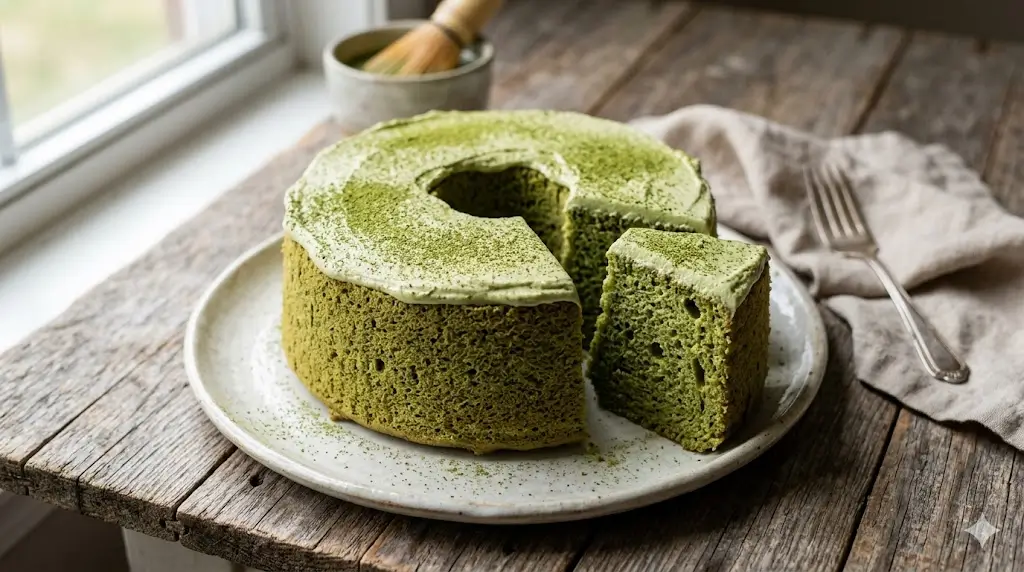
Cake Flour (1 ¼ cups): You must use cake flour, not all-purpose. Its low protein content prevents tough gluten from forming, ensuring the crumb remains exceptionally tender and soft.High-Quality Matcha Powder (2 tablespoons): The star ingredient. Use a premium culinary grade or ceremonial grade matcha. It should be vibrantly bright green. Dull, yellowish matcha will yield a muddy-colored cake with a bitter, fishy aftertaste.Granulated Sugar (1 cup, divided): Used to sweeten the batter and, crucially, to stabilize the egg whites. You will use ½ cup in the egg yolk batter and ½ cup in the meringue.Large Eggs (6 whole, separated): You need 6 egg yolks and 6 egg whites. They must be separated carefully (no yolk in the whites!) and should be at room temperature for maximum volume.Neutral Vegetable Oil or Canola Oil (½ cup): Unlike butter, oil remains liquid at room temperature. This is the scientific secret to a chiffon cake that stays incredibly moist and soft, even when chilled.Whole Milk or Water (½ cup): Adds necessary hydration to the thick egg yolk batter. Milk adds a touch of richness, while water allows the pure tea flavor to shine brighter.Baking Powder (1 ½ teaspoons): Provides a small amount of chemical lift to assist the whipped egg whites.Cream of Tartar (½ teaspoon): An acidic powder that stabilizes the egg whites, helping them whip to stiff peaks quickly and preventing them from deflating while folding.Fine Sea Salt (½ teaspoon): A critical flavor enhancer that cuts through the sweetness and balances the mild grassy notes of the tea.Pure Vanilla Extract (1 teaspoon): Adds sweet, floral aromatic notes that beautifully round out the earthy matcha profile.
Equipment

  • A 9-inch or 10-inch aluminum tube pan with a removable bottom (Do not use a non-stick pan, and absolutely do not use a bundt pan).
  • A stand mixer with a whisk attachment or a powerful electric hand mixer.
  • A fine-mesh sieve or sifter.
  • A sturdy wire whisk and a large, flexible silicone spatula for gentle folding.
  • Measuring cups and spoons (or a digital kitchen scale for optimal accuracy)
  • A sturdy wire cooling rack, or a glass bottle to invert the tube pan over.
  • Large and medium mixing bowls (preferably glass or stainless steel; avoid plastic as it holds residual oils that ruin egg whites).

Method
 

  1. Step 1: Prep the Oven and Sift Dry Ingredients

    Preheat your oven to 325°F (160°C). Make sure your oven rack is in the lower third position. Do not grease your tube pan. A chiffon cake must literally grip and climb the raw aluminum walls of the pan to reach its maximum height. In a medium bowl, sift together the cake flour, 2 tablespoons of matcha powder, baking powder, and salt. Sifting is crucial to remove the stubborn clumps that matcha naturally forms.

    Step 2: Mix the Yolk Batter

    In a large mixing bowl, whisk together the 6 egg yolks and ½ cup of the granulated sugar until pale and well combined. Add the neutral oil, milk (or water), and vanilla extract. Whisk vigorously until the mixture is fully emulsified. Gradually add the sifted green dry ingredients to the wet yolk mixture, whisking just until the batter is smooth, thick, and vibrantly green. Set this bowl aside.

    Step 3: Whip the Meringue

    In the impeccably clean glass or metal bowl of your stand mixer, add the 6 egg whites. Beat on medium-low speed until they become foamy. Add the ½ teaspoon of cream of tartar. Increase the speed to medium-high and gradually pour in the remaining ½ cup of granulated sugar, about a tablespoon at a time. Continue to whip until the whites reach stiff, glossy peaks. When you pull the whisk out, the peak should stand straight up without bending over.

    Step 4: Master the Art of Folding

    This is the most critical step. Take one-third of the stiff egg whites and add it to the heavy green yolk batter. Use your whisk to gently mix this in; this is called "sacrificing" the whites to lighten the dense batter. Next, switch to a large silicone spatula. Add the remaining egg whites in two batches. Gently cut down the center of the bowl, scrape along the bottom, and fold the batter over the top (the "J-fold"). Rotate the bowl as you go. Fold only until no white streaks remain. Do not overmix, or you will deflate the air you just whipped in.

    Step 5: Bake the Chiffon

    Gently pour the light, airy batter into your ungreased tube pan. Run a thin knife or wooden skewer through the batter in a circular motion to break up any large trapped air pockets. Bake for 45 to 50 minutes. The top should spring back gently when touched, and a wooden skewer inserted into the center should come out clean.

    Step 6: Invert and Cool Completely

    The moment you remove the pan from the oven, immediately invert it upside down. If your tube pan has little feet, let it rest on those. If not, invert the center tube over the neck of a heavy glass bottle. You must let it cool completely upside down for at least 2 hours. If you cool it right-side up, gravity will collapse the delicate crumb.

    Step 7: Unmold and Serve

    Once completely cool, flip the pan right-side up. Run a thin, flexible knife or a metal offset spatula closely along the outer edge of the pan to release the sides, pressing firmly against the metal. Push the removable bottom up to extract the cake. Run the knife along the bottom plate and the center tube to fully release it. For beautiful presentation ideas, explore cake decoration for beginners.