Go Back
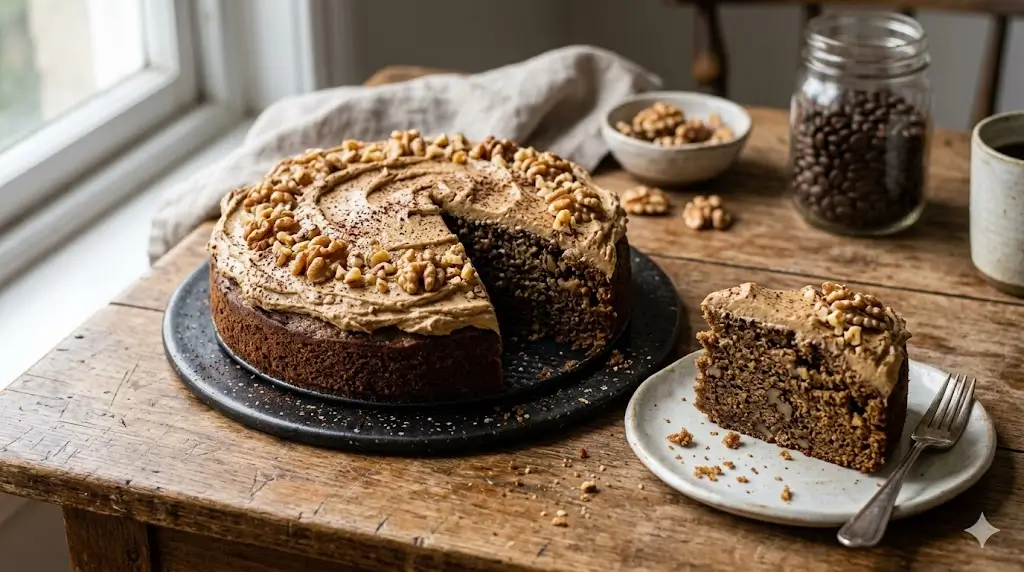
Espresso Coffee Walnut Cake 7 Best Baking Tips

Espresso Coffee Walnut Cake 7 Best Baking Tips

: Struggling with weak coffee flavor? Bake the ultimate Espresso Coffee Walnut Cake with our 7 tips for a moist crumb and rich frosting. Discover, Learn, Try.
Prep Time 15 minutes
Cook Time 30 minutes
Total Time 44 minutes
Servings: 4 people
Course: Dessert
Cuisine: American
Calories: 250

Ingredients
  

Instant Espresso Powder (2 ½ tbsp): The star ingredient. You must use espresso powder, not standard instant coffee granules. Espresso powder is much more concentrated and dissolves seamlessly to provide a deep, dark roast flavor without adding excess liquid to the batter.Hot Whole Milk (3 tbsp): Used specifically to "bloom" the espresso powder, unlocking its full aromatic potential before it hits the flour.All-Purpose Flour (2 cups): Provides the necessary structural backbone to support the heavy chopped nuts without making the crumb too dense.Light Brown Sugar (1 ½ cups): The molasses in the brown sugar pairs perfectly with the bitterness of the coffee, adding immense moisture and deep caramel notes that white sugar simply cannot provide.Unsalted Butter (1 cup, softened): Using unsalted butter allows you to control the exact sodium levels. It must be at room temperature to trap air during the creaming process.Large Eggs (4 whole, room temperature): Act as the primary binding agent, emulsifying the butter and providing lift and structure.Chopped Walnuts (1 ½ cups, divided): Provide a necessary textural contrast. You will fold 1 cup into the batter and save the remaining half-cup for garnishing the frosting.Baking Powder (2 tsp) & Baking Soda (½ tsp): The leavening system required to lift the batter and create a light, airy sponge.Pure Vanilla Extract (1 tbsp): Adds sweet floral notes that round out the sharp, bitter edges of the espresso.Fine Sea Salt (¾ tsp): A critical flavor enhancer that cuts through the sweetness and elevates the roasted nut profile.For the Espresso Mascarpone Frosting: 8 oz mascarpone cheese (chilled), ½ cup unsalted butter (softened), 3 cups powdered sugar, 1 tbsp espresso powder dissolved in 1 tbsp heavy cream.
Equipment

  • Two 8-inch light-colored aluminum round cake pans (dark pans can overbake the edges)
  • Parchment paper rounds (an absolute necessity for a flawless pan release)
  • A stand mixer with a paddle attachment, or a robust electric hand mixerLarge and medium mixing bowls (preferably glass or stainless steel)
  • A sturdy wire whisk and a flexible silicone spatula
  • Sturdy wire cooling racksAn offset spatula for applying the frosting
  • A small skillet for toasting the walnuts
  • Measuring cups and spoons (or a digital kitchen scale for optimal accuracy)

Method
 

  1. Step 1: Prep Pans and Toast Walnuts

    Preheat your oven to 350°F (175°C). Grease your two 8-inch cake pans with butter and line the bottoms with parchment paper. Next, place your chopped walnuts in a dry skillet over medium heat. Toast them for 4 to 5 minutes, tossing frequently, until they become incredibly fragrant and slightly darker in color. Remove them from the pan immediately so they don't burn, and let them cool. Toasting prevents them from getting soggy in the batter.
    .
  2. Step 2: Bloom the Espresso

    In a small bowl, combine the instant espresso powder with the hot whole milk. Stir vigorously until the powder is completely dissolved. This step is known as "blooming." The heat activates the flavor compounds in the coffee, ensuring your cake has a rich, bold espresso taste rather than a weak, diluted one. Set this mixture aside to cool slightly.
  3. Step 3: Whisk the Dry Ingredients

    In a medium-sized mixing bowl, thoroughly whisk together the all-purpose flour, baking powder, baking soda, and fine sea salt. Whisking aerates the dry ingredients and ensures the leavening agents are distributed evenly, preventing any large, bitter holes in your baked sponge.
  4. Step 4: Cream the Butter and Sugar

    In the bowl of your stand mixer fitted with the paddle attachment, beat the softened butter on medium-high speed for 1 minute. Add the light brown sugar and continue to beat for 3 to 4 minutes until the mixture is pale, airy, and noticeably fluffy. This crucial step forces microscopic air bubbles into the fat, dictating the ultimate lightness of your dessert.
  5. Step 5: Emulsify Eggs and Flavorings

    Reduce the mixer speed to medium-low. Add the room-temperature eggs one at a time, allowing each to fully incorporate before adding the next. Stop to scrape down the sides of the bowl with your silicone spatula. Pour in the pure vanilla extract and your bloomed espresso mixture, blending until the batter is a beautiful, uniform caramel color.
  6. Step 6: Fold in Flour and Nuts

    Turn the mixer to its lowest speed. Gradually add the whisked dry ingredients, mixing only until the last streaks of flour disappear. Overmixing here develops gluten and will make your cake tough. Remove the bowl from the mixer and use your spatula to gently fold in 1 cup of the toasted, cooled walnuts.
  7. Step 7: Bake, Cool, and Frost

    Divide the batter evenly between the prepared pans. Bake for 30 to 35 minutes, or until a wooden skewer inserted into the center comes out clean. Let the cakes cool in the pans for 10 minutes before turning them out onto a wire rack to cool completely. Once completely cool, whip your mascarpone frosting and apply it evenly. For beautiful piping techniques, check out cake decoration for beginners, or try something structurally complex from our advanced cake decorating guide