Ingredients
Equipment
Method
Step 1: Whisk and Aerate the Dry Ingredients
Preheat your oven to 325°F (165°C). We use a slightly lower temperature for pound cakes to ensure the dense center cooks completely before the outside burns. Generously grease your loaf pan with butter or baking spray and line it with a parchment paper sling. In a medium mixing bowl, place your fine-mesh sieve over the top and sift together the all-purpose flour, almond flour, baking powder, and fine sea salt. Whisking these together ensures a perfectly even distribution of the leavening agents and breaks up any clumps in the almond flour. For those looking to master the exact science behind these precise ingredient alterations, reviewing cake baking formulas and ratios can drastically improve your foundational skills.Step 2: Cream the Butter and Sugar Meticulously
In the bowl of your stand mixer fitted with the paddle attachment, beat the softened, room-temperature butter on medium-high speed for 2 minutes until it is smooth and creamy. Gradually pour in the granulated white sugar. Continue to beat for a full 5 to 7 minutes until the mixture is exceptionally pale, light, fluffy, and significantly increased in volume. Do not rush this step! This mechanical aeration is what gives the pound cake its delicate lift. If you are new to the creaming method, you might find our comprehensive resource on baking cakes for beginners highly beneficial for mastering these foundational mixing techniques.Step 3: Emulsify the Eggs and Aromatics
Reduce the mixer speed to medium-low. Add the room-temperature eggs one at a time, allowing each egg to fully incorporate into the butter mixture before adding the next. Stop the mixer frequently to thoroughly scrape down the sides and bottom of the bowl with your silicone spatula. If the mixture begins to look curdled, your eggs were likely too cold, but do not panic—the flour will bring it back together. Add the sour cream, pure almond extract, and vanilla extract, mixing until smoothly combined.Step 4: Alternate Dry Ingredients and Amaretto
With the mixer on the lowest possible speed, add the dry flour mixture in three equal parts, alternating with the Amaretto liqueur in two parts (always begin and end with the dry ingredients). Mix only until just combined; do not overmix. Overmixing develops the gluten network in the flour, resulting in a dense, tough, rubbery cake rather than a tender crumb. Mastering this delicate folding process is one of the many cake baking tips and techniques that permanently separate amateur home bakers from seasoned pastry professionals.Step 5: Bake and Soak the Pound Cake
Pour the incredibly fragrant, thick batter into your prepared loaf pan. Smooth the top with a small offset spatula. Tap the pan gently on the counter twice to release any trapped air bubbles. Bake on the middle rack for 55 to 65 minutes. The cake is done when the top is golden brown, cracked down the center, and a skewer inserted into the deepest part comes out clean. Allow the cake to cool in the pan for 15 minutes. While still warm, poke deep holes all over the top of the cake with your skewer and brush 2 extra tablespoons of pure Amaretto liqueur over the surface, allowing it to soak into the crumb for maximum moisture.Step 6: Glaze and Garnish
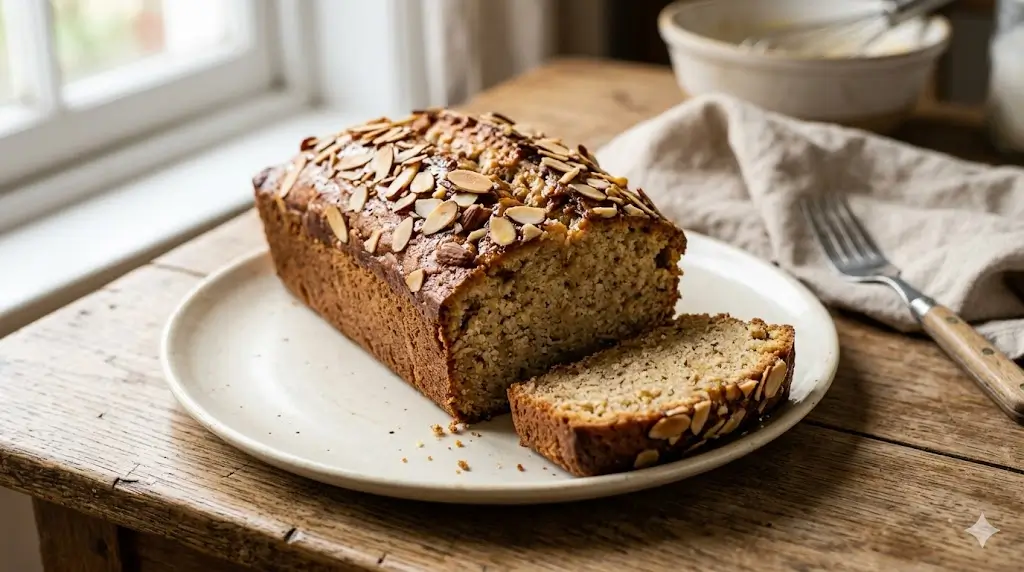
Once the cake is completely cool to the touch, carefully remove it from the pan using the parchment sling and transfer it to a wire rack. In a small bowl, whisk together the sifted powdered sugar, Amaretto, and heavy cream until perfectly smooth. The glaze should be thick but pourable. Pour the glaze generously over the top of the cake, letting it drip beautifully down the sides. Immediately sprinkle the toasted sliced almonds over the wet glaze so they adhere.