Did you know that the difference between a Michelin-starred sponge and a dense kitchen disaster often comes down to a mathematical deviation of less than 3%? It is a startling reality that many home bakers overlook: baking is not a culinary art governed by intuition, but a branch of structural engineering defined by Cake Baking Formulas & Ratios. While the average cook might view a recipe as a suggestion, a professional pastry chef views it as a precise equation where the variables of weight, hydration, and aeration must be perfectly balanced to achieve structural equilibrium. At cakeformula.com, we believe that once you master the “Master Ratios,” you no longer need to follow recipes—you can begin to write them.
This comprehensive guide serves as your mathematical manifesto. We are pulling back the curtain on the hidden numbers that hold your cakes together. By understanding the Cake Baking Formulas & Ratios used by the world’s top bakeries, you will gain the power to troubleshoot any bake, adjust for altitude, and innovate with confidence. We aren’t just baking a cake; we are solving for “perfection.”
The Master Ratio Pantry: Ingredients for the 1:1:1:1 Method
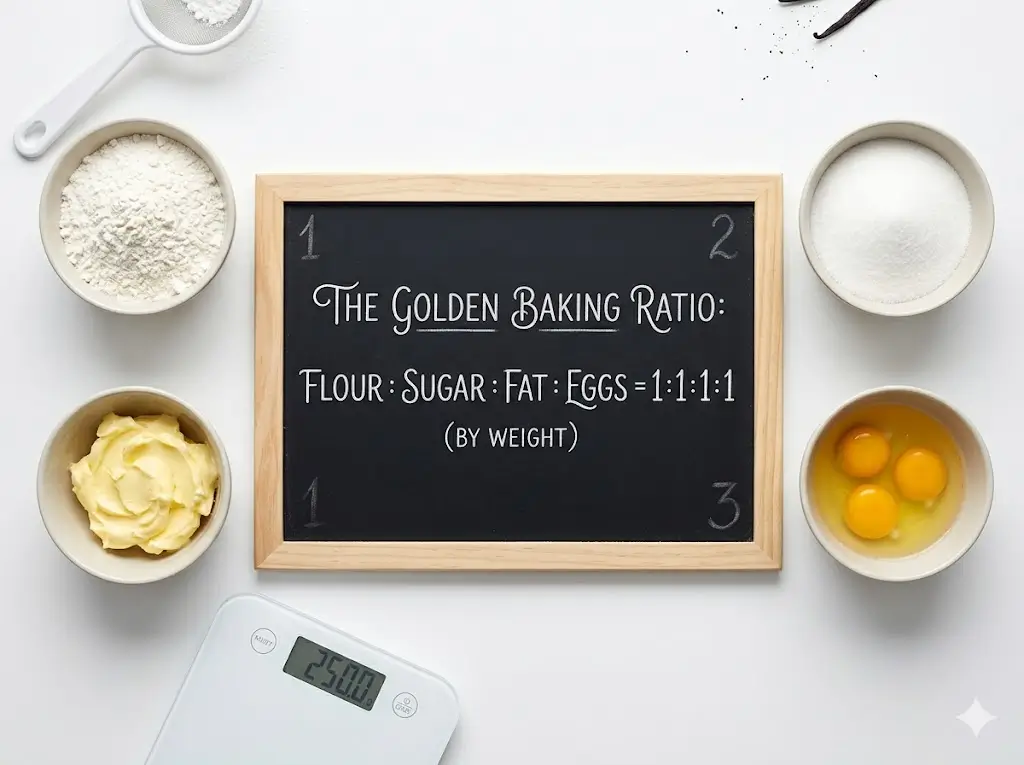
To demonstrate the power of Cake Baking Formulas & Ratios, we will focus on the “Professional High-Ratio Sponge.” This recipe is the ultimate expression of baker’s percentages, where every ingredient is measured relative to the weight of the flour.
The Component Breakdown (The Formula Baseline)
- Unbleached Cake Flour (100% / 500g): In the world of ratios, flour is always 100%. It is the “Master Unit” that determines the weight of everything else.
- Superfine Granulated Sugar (100-110% / 500-550g): According to the “High Ratio Rule,” the weight of the sugar should always meet or slightly exceed the weight of the flour to ensure maximum tenderness and moisture retention.
- Unsalted Cultured Butter (50% / 250g): For a high-ratio cake, the fat content is usually half the weight of the flour, providing enough richness without making the crumb greasy. Substitution: For a more traditional pound cake ratio, increase to 100% (500g).
- Large Whole Eggs (100% / 500g): Eggs provide the protein structure. The weight of the eggs should equal the weight of the flour to provide sufficient “lift” and binding.
- Whole Milk (75% / 375ml): Liquid hydration is key. This percentage ensures the starches gelatinize perfectly without diluting the flavor.
- Double-Acting Baking Powder (3-4% of flour weight): Approximately 15-20g. This provides the chemical lift that complements the mechanical aeration.
- Fine Sea Salt (1% of flour weight): 5g. Essential for stabilizing gluten and enhancing the sweetness of the sugar.
Timing: The Chronology of Mathematical Curing
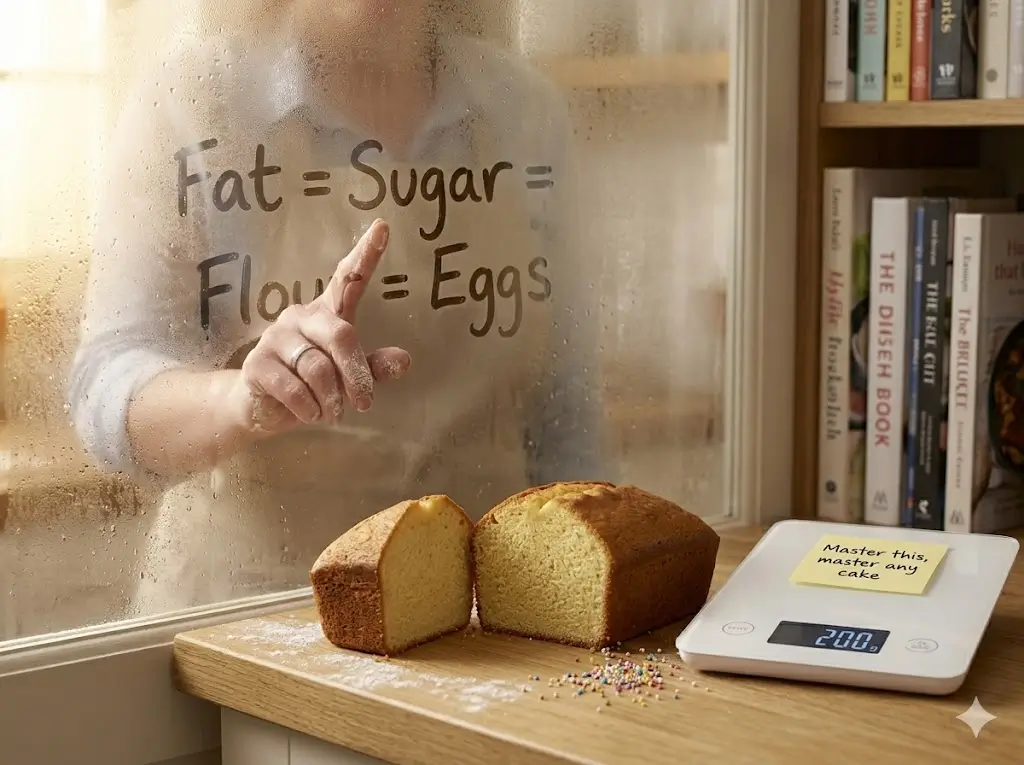
Precision timing is a variable in your Cake Baking Formulas & Ratios. If your oven dwell time is off, the chemical reactions of the ratio will not reach completion. This Master Formula requires approximately 95 minutes, which is 15% more time than standard quick-mixes to allow for the high sugar and liquid content to set correctly.
- Mise en Place (Weighting & Scaling): 25 minutes
- Emulsion & Aeration Phase (Mixing): 20 minutes
- Thermodynamic Set (Baking): 40–45 minutes
- Structure Stabilization (Cooling): 10 minutes
- Total Time Investment: 95 minutes
Step-by-Step Instructions: Mastering the Ratios
1. The Scaling Protocol
The first law of Cake Baking Formulas & Ratios is that volume is irrelevant. Throw away your measuring cups. Use a high-precision digital scale to weigh your flour, then calculate the weights of your other ingredients based on the percentages provided. Ensure your kitchen is at a stable 70°F (21°C); temperature is a hidden variable that can expand or contract the volume of your fats, ruining the ratio.
2. The High-Ratio Mixing Method
Unlike the creaming method, high-ratio cakes often use the “Reverse Creaming” or “Paste” method. Combine your flour, sugar, salt, and leavening agents in the bowl. Add your softened butter and half of the liquid. Mix on low until it looks like a thick paste. This coats the flour particles in fat before the liquid activates the gluten, which is the secret to the “melt-in-your-mouth” texture defined by these specific Cake Baking Formulas & Ratios.
3. The Structural Egg Integration
Whisk your eggs with the remaining liquid and vanilla. Add this to the paste in three stages. Scrape the bowl after every addition. This stage is where you are building the “Emulsion Matrix.” If you add the liquid too fast, the ratio breaks, and the fat will separate from the protein, leading to a “leaking” cake.
4. The Hydration Calculation
Allow the batter to rest for 5 minutes before pouring into the pans. This gives the flour starches a chance to “hydrate”—absorbing the milk and egg liquids. In the science of Cake Baking Formulas & Ratios, a rested batter produces a more uniform crumb and reduces the chance of large, unsightly air tunnels.
5. Atmospheric De-Gassing
Tap the pans firmly on the counter. Because high-ratio cakes have a high liquid content, they are prone to trapping large steam bubbles. Tapping the pans ensures the “Formula” sets with a dense, fine-pored structure that looks professional when sliced.
6. The “Low and Slow” Bake
Because this ratio contains a high percentage of sugar, it will brown faster than a standard cake. Bake at 325°F (160°C). This lower temperature allows the middle of the cake to reach 205°F (96°C)—the “Point of Coagulation”—without the exterior becoming bitter or burnt.
7. The Vapor Redistribution
Cool the cake in the pan for exactly 10 minutes. This is part of the “Formula.” As the temperature drops, the steam inside the cake redistributes, hydrating any dry spots. Invert onto a wire rack to finish cooling.
Nutritional Information: The Anatomy of a High-Ratio Slice
Understanding the data behind Cake Baking Formulas & Ratios allows for better nutritional management. High-ratio cakes are denser and more satisfying than foam cakes.
| Nutrient | Amount per Serving | Ratio Insight |
|---|---|---|
| Calories | 385 kcal | High due to 1:1 sugar/flour ratio |
| Total Fat | 22g | Derived from 50% fat ratio |
| Saturated Fat | 14g | Critical for structural stability |
| Carbohydrates | 42g | Reflects the high sugar hydration |
| Protein | 6g | Boosted by 100% egg weight |
| Fiber | 1g | Primarily from flour starches |
Healthier Alternatives for the Formula
Can you change the math without breaking the cake? Yes, if you swap ingredients while maintaining the Cake Baking Formulas & Ratios weight totals:
- The Ancient Grain Swap: Replace 100% of the cake flour with spelt flour. Because spelt has a different protein structure, you must decrease your mixing time by 20% to prevent the cake from becoming tough.
- The Natural Sweetener Logic: Use coconut sugar. However, coconut sugar is more acidic than white sugar, so you must add 1/8 tsp of baking soda to your “Formula” to keep the pH balanced and the rise consistent.
- The Plant-Based Emulsion: Replace the 500g of eggs with 300g of aquafaba and 200g of unsweetened soy yogurt. This maintains the 100% weight ratio of “binders” while making the recipe vegan-friendly.
Serving Suggestions: Showcasing the Crumb
A cake built on perfect Cake Baking Formulas & Ratios has a specific “Tight Crumb” that should be showcased:
- The “Cold-Cut” Technique: Chill this cake before slicing. The high butter and sugar content makes it incredibly firm when cold, allowing for the razor-sharp slices you see in high-end pastry shops.
- The Simple Syrup Wash: Professional bakers often brush the layers with a “1:1 Syrup” (equal parts sugar and water). This reinforces the hydration ratio and keeps the cake fresh for up to 7 days.
- Palate Cleansing Pairings: Serve with an unsweetened crème fraîche or a tart lemon sorbet. The acidity provides a sharp contrast to the 100% sugar ratio, making the dessert feel balanced.
Common Mistakes to Avoid: The “Math Fails”
- Trusting the Measuring Cup: This is the #1 reason for failure. A “cup” of flour can vary by 30 grams. In Cake Baking Formulas & Ratios, 30 grams is the difference between a sponge and a brick.
- Ignoring the Liquid-to-Sugar Rule: If your liquid weight exceeds your sugar weight by more than 20%, the cake will likely collapse because the structural proteins are too diluted to hold the weight of the air.
- Cold Egg Shock: If your eggs are at 40°F instead of 70°F, they will cause the fat in your ratio to seize, preventing the formation of a smooth emulsion.
- Expired Leavening: If your baking powder is old, the chemical “lift” won’t happen, and the structural “Master Ratio” will simply produce a dense, flat disk.
- Over-mixing the Flour: Once the flour meets the liquid, the “Gluten Timer” starts. Mix for more than 2 minutes, and you’ve changed the formula from “Cake” to “Bread.”
Storing Tips for Maintaining Freshness
Preserving the results of your Cake Baking Formulas & Ratios is all about moisture management.
- The Sugar Preservation: Because this recipe has a 1:1 sugar ratio, it is naturally more shelf-stable than most cakes. Sugar acts as a preservative by binding to water, making it unavailable for mold growth.
- The Double-Wrap Method: Wrap the cake layers in plastic wrap, then aluminum foil. This creates a “dual-barrier” that prevents the fridge’s dry air from pulling moisture out of the ratio-balanced crumb.
- The Freezing Science: You can freeze these layers for up to 3 months. The high sugar content prevents large ice crystals from forming, which means the texture is identical to fresh once thawed.
Conclusion
Mastering Cake Baking Formulas & Ratios is the true hallmark of a professional baker. By moving away from volume-based guessing and toward weight-based precision, you ensure that every cake you bake at cakeformula.com is a triumph of culinary engineering. We invite you to try this “Master Ratio” and share your results! Leave a comment below or subscribe to our blog for more data-driven baking updates.
FAQs
Q: What is a “High-Ratio” cake exactly?
A: A high-ratio cake is one where the weight of the sugar is equal to or greater than the weight of the flour. This produces the moist, fine-grained texture found in high-quality commercial cakes.
Q: Why is flour always 100%?
A: In “Baker’s Percentages,” we treat the main structural ingredient (flour) as 100% so we can easily calculate the weights of everything else. It makes scaling a recipe up or down a simple math problem.
Q: Can I change the ratio to make a lighter cake?
A: Yes. If you decrease the butter to 25% and the sugar to 80%, you will get a lighter, “spongier” cake, but it will dry out faster and have less flavor.
Q: Does the type of sugar affect the ratio?
A: Yes. Brown sugar contains molasses (liquid), so if you swap white for brown, you should decrease your milk by 1 tablespoon to keep the hydration ratio balanced.
Q: What happens if I use too much baking powder?
A: The cake will rise too fast, the air bubbles will merge into one giant bubble, and then the whole structure will collapse because the protein “Formula” wasn’t strong enough to support the oversized air pockets.